
At Deenabandhu, science is not restricted by high budgets and expensive laboratory equipment. Through innovation and a deep-rooted local perspective, they have made science accessible to every child.
For years, Jayadev, the founder of Deenabandhu, has carried a deep passion for teaching science in ways that are practical, joyful, and accessible. That passion led him to start the Deenabandhu Teacher Resource Center, which has grown into a remarkable collection of science teaching-learning materials made largely from inexpensive, locally available resources. Deenabandhu has spent over two decades building a strong Teacher Resource Center that creates teaching-learning materials from local materials, often linking experiments to local themes. This is the spirit behind the proposed science gallery.
A Different Kind of Science Kit
Most schools imagine science equipment as something that must be bought, relying on often expensive kits and equipment sold by vendors. Jayadev and his team have taken a different path. Their operations operate on different questions. What can be made locally? What can be repaired locally? What can a teacher recreate in another school with ordinary materials?
During COVID, the team developed a telescope that cost nearly ten times less than conventional alternatives. They also designed a simple microscope using the lens from a cheap flashlight costing about ₹15. When paired with a mobile phone camera, this handmade microscope can magnify organisms in a few drops of water, revealing a hidden world inside what appears to be clear water.
For a school that cannot afford a standard microscope, such a “crude” invention is not limiting. It is liberating. It gives children their first chance to see life at a scale that was previously invisible to them. Teaching science is no longer limited by having the perfect equipment available.
Learning by Doing
The Science Fair at Deenabandhu showed how deeply this approach resonates with children and teachers. In 2023, when Asha Boston volunteer Melli visited, the campus welcomed more than 2,500 students from 56 schools, drawing participation from schools across Chamarajanagar and nearby areas. The district DDPI also attended the inauguration, a sign of Deenabandhu’s growing connection with the public education system.
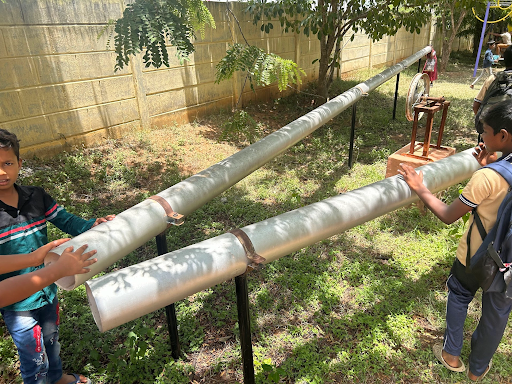
The school rooms were organized around themes such as heat, light, magnetism, mathematics, statistics, and climate change. The courtyard hosted regular chemistry demonstrations, while the Science Park and Science Gallery gave children access to larger models and interactive exhibits.
The photos from recent visits capture the same story visually: children crowding around a science activity in the park, and long queues waiting to enter the Science Gallery. These are not passive visitors walking past displays. They are eager participants, waiting for their turn to see, touch, try, and understand.
Probability with Tamarind Seeds
One of the most memorable exhibits was also the simplest. There are six containers, a die, and a pile of tamarind seeds or beans. Each child rolls the die and drops a seed into the container matching the number rolled. One roll does not prove much. Ten rolls may look uneven. But over the course of a day, as hundreds or thousands of children participate, the pattern becomes clear: each container ends up with approximately the same number of seeds.
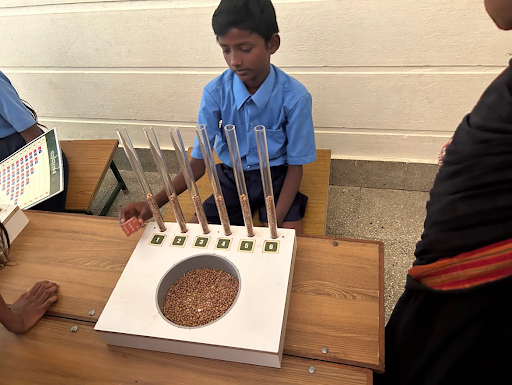
In this single activity, children experience probability before they are asked to define it. What is normally a complicated and confusing topic for children becomes something tangible and applicable. With around 2,500 children visiting from 56 schools, the jars had roughly equal numbers of beans by the end of the day. It is hard to imagine a more elegant teaching tool, one that is low-cost, participatory, visual, and unforgettable.
Local Materials, Local Skills, Local Ownership
Deenabandhu’s science materials are impressive not only because they are affordable, but because they are rooted in the local ecosystem. Wherever possible, the team works with local carpenters and craftspeople to build exhibits and models.
This is one of the most crucial aspects to Deenabandhu’s success. It keeps costs low, creates local employment, and ensures that the knowledge of building and maintaining these materials stays within the community. A science exhibit is no longer an imported object that must be protected behind glass. It becomes something the community can understand, repair, adapt, and improve.
This approach also sends children a powerful message that science is not something that comes only from faraway laboratories or expensive institutions. It can be built in their own town, from familiar materials, by people they know. This kind of thinking is the kind of ingenuity that turns people into scientists and engineers.
Science Gallery and the Need for a Bigger Space
One of the spaces built by Deenabandhu is a Science Gallery. The success of Deenabandhu’s science work has created a practical challenge.
During science events, children gather in large numbers around each exhibit in the gallery. Queues form outside. Many students must watch from a distance instead of getting a chance to engage one-on-one. The very enthusiasm that makes the program so inspiring also shows why expansion is needed.
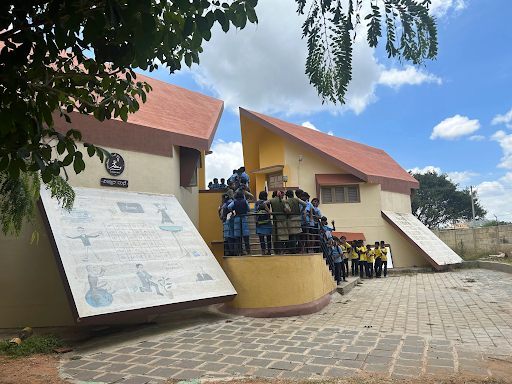
A larger Science Gallery would allow more children to interact directly with exhibits in electricity, magnetism, light, statistics, and other areas. It would give teachers more room to demonstrate concepts. It would help visiting schools experience the exhibits in a deeper, less crowded way.
Most importantly, it would preserve the heart of Deenabandhu’s model: science as a hands-on experience, not a lecture.
A Place Where Curiosity Becomes Confidence
Asha Boston’s volunteers have found that the children at Deenabandhu are not afraid of science. The Science Fair generates excitement comparable to an annual day celebration, and children are involved in planning and execution for weeks beforehand. That may be the greatest achievement of this work.
When children build, observe, experiment, and explain, science stops being intimidating. A bulb, a magnet, a swing, a lens, a bottle, a die, or a handful of seeds becomes a doorway into understanding. Children begin to see science not as a subject to fear, but as a way to ask questions about the world around them. The gallery is an investment in that confidence. We hope to have your continued support in showing every child that they can be a scientist.