
Background
Asha Boston has always believed in the power of books. A book can carry a reader to a faraway place, introduce them to new people, and open their minds to new ideas that change the way they see the world. Today is the era of digital content, yet the tactile pleasure of holding a book and turning a page can be magical.
But we have learned that providing resources is only the first step, and often an insufficient one. Books alone cannot change anything in a school, it is the teachers who use them who do.
Books are popular donations to schools. But the books are often carefully stored away, brought out to show visitors. Or given to children during a compartmentalized library period and locked away afterwards. Rare are the libraries with books that have dog-eared pages and binding that is creased. Unless the teachers and librarians themselves appreciate reading, they cannot help children do so.
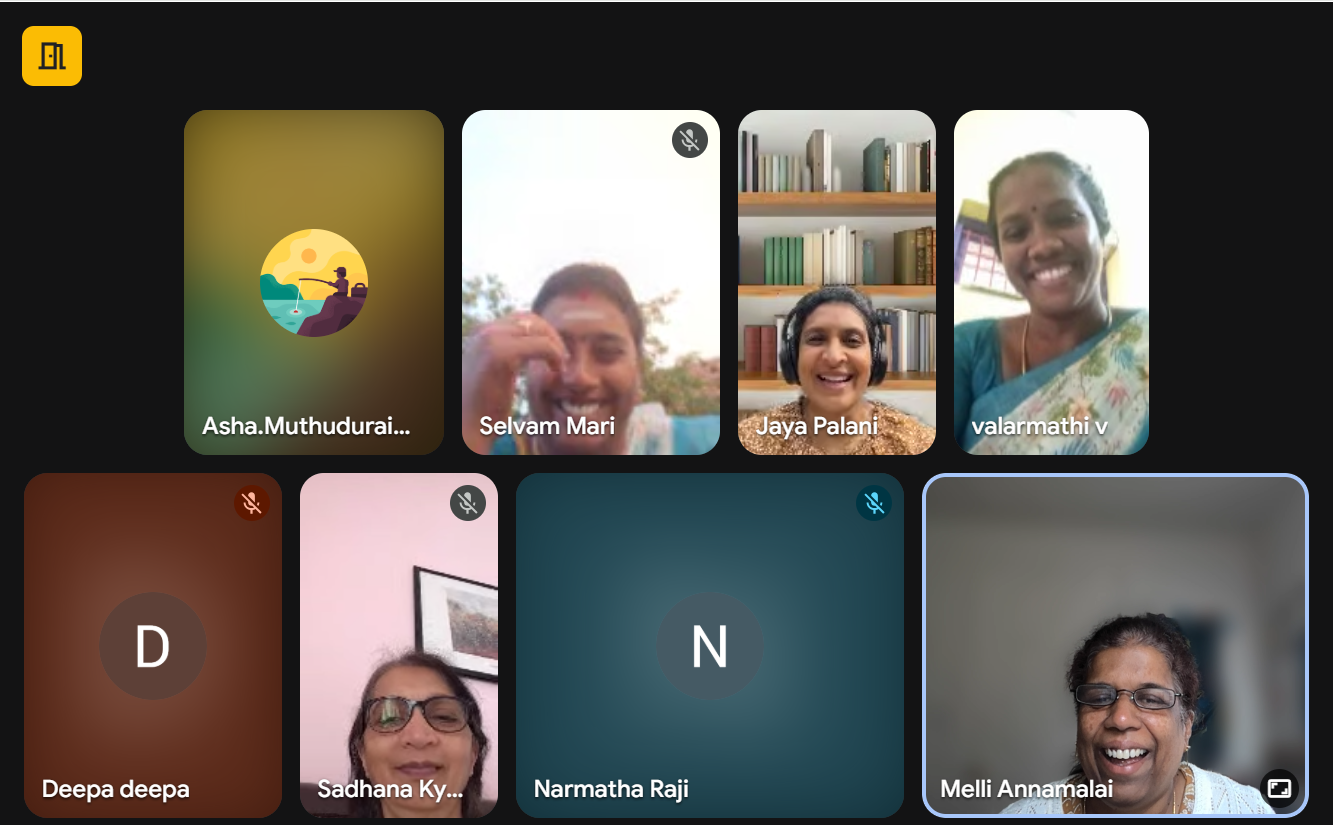
At an Asha holiday gathering on a cold December day an idea was born: a Book Club for teachers and librarians, to help them appreciate reading and develop a reading habit. Interested volunteers from Asha Boston and teachers/librarians from libraries we support would be the members of this book club. We would start with short stories. We would decide on the story to read, and meet bi-weekly and discuss that story. Just like any other book club in the world. We would start with the libraries we support in Tamil Nadu, so this meant the books we read would be in Tamil.
The Book Club Today
So, where are we after a year of book club meetings?
All meetings are virtual, between volunteers spread across the Boston area and teachers spread across villages in Tamil Nadu. Each meeting is an hour long. We started with R. K. Narayan’s short story collection Malgudi Days, partly because there was a good Tamil translation of the original English, enabling Asha Boston volunteers who didn’t know Tamil to join in. From there we have journeyed through worlds created by writers Ki Rajanarayanan, Ambai, Dilip Kumar, Jayakanthan, Jeyamohan, and more recently, Imayam. These stories span rural settings (authors like Ki Ra) and urban neighborhoods (authors like Dilip Kumar), set in time periods over the last few decades (R.K Narayan’s stories from the 50s and 60s to Ambai’s stories from the 70s and 80s to Imayam’s contemporary stories). Asha Boston volunteers are also learning in the process, as the book club opens their eyes to Tamil authors they have not encountered before (and is greatly improving my Tamil reading skills).
We moved quickly moved from one story per session to two.
In the early sessions the teachers were quiet. When asked to speak their comments were mostly descriptive – a brief summary of the story, and perhaps a connection to their own lives. Sometimes I would give hints or highlight aspects of the story I found interesting and encourage them to do the same.
In the course of a year how dramatically that has changed!
Now, the teachers lead the discussion. They arrive with opinions. Whether they like the story and why or why not, and how it compares to other stories they have read. They make comments on literary techniques (“the story timeline spans only one hour or so, yet a complete story is within it”). When an author leaves an ending open they ponder why this was so. When a story is less than satisfactory they wonder whether another author would have written the story differently. They are candid about sharing their thoughts, and not shy of disagreeing with each other or with us. They share what moved them, what they laughed at, what puzzled them. In short, they think critically about each story, form their own opinions, and on occasion write a short review. This, I think, is the essence of learning, and in the case of reading, this is the foundation of a lasting reading habit.
Jaya and I, who participate regularly from Asha Boston have a perspective shaped by growing up in urban India and living now in the US, while the teachers’ perspective comes from the rural villages and the society they live in. Each meeting is a rich discussion of these multiple perspectives.
It is particularly fascinating when a reader interprets a story in an entirely new way. When we read the Yellow Fish by Ambai last month, there is a sentence about a fish being tossed aside because it has no commercial value. With no thought given to the life that was lost, about how futile that loss was. Its life dismissed. One of the teachers had an entirely novel interpretation of that line – the discarded fish made her think of how a woman and her aspirations are discarded by society without a thought. I loved it.
Some stories make them cry. Some make them laugh. Some make them think of society in a new way. This is what a good story should do. “We look forward to hearing the different interpretations,” said one. “Why hasn’t Sadhana been able to join us, her perspective was always different.” “Each story is like a movie unfolding in front of our eyes,” said another. And what was music to my ears, “We look forward to these sessions.”
The teachers look forward to the meetings, this is no forced “training” session. When we had a conflict because of the Asha India conference they would rather move the next meeting ahead by a week than postpone it by a week. They read parts of a story beforehand to make recommendations on what to read next. Some spoke more in the early sessions, now others have blossomed. Voices that were once hesitant now join the conversation with depth and confidence.
What is special about the book club?
We follow the general principles Jaya outlined at the beginning: give everyone a voice, treat everyone as equals, welcome every perspective as valid, conduct all discussions with mutual respect. No single voice should dominate. Everyone belongs.
This foundation has helped us grow into a warm, friendly and nurturing space, where every participant is articulate and confident, and alive to the pleasures of reading. People who once barely read now not only enjoy stories they analyze them. And want to read more.
What can we learn from this?
Several Asha projects run participatory sessions for teachers on Science learning or other topics perceived as complex. With the Book Club we take that approach to reading.
In any area, Science, Mathematics, Reading, History, IT, the goal is the same: enable teachers to think for themselves. Kindle their natural curiosity and that will spill over into their classrooms. That is the North Star we are aiming for, in this case by reading stories together. We are making real progress and we get to read new authors. Isn’t volunteering fun?
Melli A.
Comments 3
Feeling very happy to read this. This is what we expected out of this process that is happening. This gives me sense of grounding towards positive action. Love. Will share with all the librarians.
This was wonderful to read. Hope the book club continues to grow and thrive.
Wondering if this can be extended to non-fiction – high quality non-fiction can be invaluable for enlarging one’s worldview.
Totally agree. We have now expanded to authors outside India (we have started reading Anton Chekov’s stores translated into Tamil). Next we want to start reading some non-fiction.